Correction. Endnote. Let me be clear here:
Teaching and occasional writing should mean just as much, if not more, than its converse. No one likes the writer who occasionally teaches. They're only sometimes good writers, and seldom good teachers.
Why does the academy let this happen?
We're an academy. We teach. Sheesh.
Thursday, July 27, 2006


neuroses
When I read an article like this one I can’t help but continue thinking about it a few days later. (Read the whole thing. Whenever. It’s a great essay.)
And then my thoughts arrive like a thunderbolt.
--Oh my god! Does the fact that I prefer, am better at, teaching writing to writing itself make me the proofreader of the writing community? Does my inherent (?) enjoyment of helping people make more sense as they write, does that mean I have to relate to the article? Am I destined to clean up, like her Burger King table-wiper? Or can I walk the walk I talk?
But in between those thoughts are about eleven million other related or slightly-related thoughts. Brewing, steeping, curing. The thoughts are usually about me, bien sûr, but aren’t I supposed to consider the manner a personal essay or personal narrative relates to me?
Which brings me to writing. Of course.
--Can one teach and never write? Can one try to write, and be better at teaching, but really want to write better?
I’ve always hated the statement/cliché/booktitle(!) that goes: Those who can, do. Those who can't, teach. I mean, I just googled it. It's alive and circulating.
But a stereotype’s a stereotype for a reason. So I must ask.
--Am I that girl?
***
Thankfully, one of the reasons I’m even sitting down to write tonight is that I’ve had a nice breakthrough on my dissertation. I feel better, mentally, about my ability to write than I have in months. Since April, I think. So I don’t actually have to delve into the question too deeply. But the idea that I might never finish my dissertation makes me nervous. Not to brag, but I have a cool plan, so I really want to write it. I really like my topic.
But lately, I’ve been drowning in reading. Reading reading reading reading reading reading reading. I could go on. Sadly, I probably will. Go on reading. I’ll stop with the reading reading reading, etc.
--So the fact that I haven’t been writing seems okay? Right? I need to read before I can write about it, right? Right? Right? Right?
***
Just kidding. I couldn't help myself.
***
--Oh, and one more thing: Should I worry that I’m still fully capable of giving others advice on their writing? That particular talent never seems to go away. Blessing? Curse? Who cares? Could I just shut my teacher’s mouth, please?
And then I reflect on the article.
What if I’m only “good for teaching”? What if I can’t actually write? Is not my career SCREWED if I can’t write? I’d say yeah.
***
Did I mention that I had a breakthrough on my dissertation? Praise to the small gods of stranded writers.
Wednesday, July 19, 2006
Saying "so long" to a culture of critique?
Writing a dissertation feels different for a lot of reasons, but I’ve been thinking about one in particular. Lately I’ve been enjoying some kinder, gentler feelings about writing that recall my classroom practices but not my “professional” writing style, which is, like most English majors, mostly critical.
A few weeks ago, I had dinner with my friend, Shannon. She’s an English major at a nearby university. During the school year, we get together to read/study/grouse about once a week, sometimes more. Before I continue, I should mention that Shannon is what the university calls a “non-traditional student,” which translates to “she’s not entering the university fresh out of high school.” Shannon is very bright. She’ll probably pursue a graduate degree in film studies, so English is a good choice. In a perfect world, Shannon would be able to focus on the conventions of various genres of writing and storytelling. However…
One of Shannon’s complaints about school centers on the inane writing assignments she is asked to complete. “Analyze the significance of the tree in Jane Eyre.” Or, “Choose one chapter of Joseph Andrews and convince your readers that it contains all of the main themes of the novel.” Or, “Write an assertion (that’s really what they call it) about what you believe to be the most important plot point. Make sure to use lots of textual evidence to support your argument.”
Not the most inspiring of prompts, you see. They ask students to “critique” the texts they’re reading, but they do not ask them to do anything with the text. The emphasis is on analysis rather than invention.
I’ve seen Shannon’s notes from class, I’ve read her “freewrites,” and I’ve talked with her about her reading—it’s clear that she knows the material back and forth. However, when it comes time to write, she often struggles to fulfill the page requirement. (Seriously, five pages about the stupid tree in Jane Eyre? Give me a break…who would want to write that much??) A prompt that asked Shannon to create a new context for the story of Jane Eyre would be perfect. “Revise the story of Jane Eyre for a modern audience, changing only one or two elements of the story.” (Think Emma to Clueless.) Or, “rewrite a chapter from JE for a modern film version. Include details about setting, character development, dialogue.” Both papers could still incorporate an argument, but it would be more of a “here are the reasons this revision is relevant/significant”.
In order to respond to these prompts, students would have to know the text, so teachers would have a means of evaluating the students’ interaction with and understanding of the material. However, students would also have an opportunity to engage with the text on a more creative, even collaborative, level.
While I was musing on Shannon’s problem, I realized that I no longer feel the need to critique my texts in the same way that I have in the past. So many of my seminar papers began with me challenging another author on his or her interpretation of a text, problem, or issue. Writing was an antagonistic, critical, analytic enterprise. I often felt that I had to tear down the critic before I could float my own ideas.
But now, as I begin this dissertation, I don’t think of composing in the same way. I mean, I still disagree with some of the interpretations I’m reading, but I’m only thinking about those differences as ways to frame my discussion. I find myself thinking about ways that I can use these other interpretations to buttress my own ideas about what I’m reading, or ways that these other authors can support me as I try to explain myself. The whole process feels more creative and collaborative rather than so argumentative. In the same way that asking a student to develop one of her own ideas using an existing text (Jane Eyre as modern social commentary, for example), this new approach allows me to see the similarities between my project and other projects and to emphasize the similarities for my own purposes.
I’ll write more on this topic in the future. For now, I’m still trying to find ways to explain what I feel. Shannon’s issue seemed like a good way to open the discussion for me. Perhaps the difference is that I have more control over how the dissertation turns out. Or maybe it’s the fact that I came up with my own question, so I can answer it in any way I want (rather than having a question posed to me and being asked to demonstrate my knowledge in a five-page response.) I don’t know yet…
But it feels great to envision my work as a part of a collaborative conversation (pardon the cliché) and less like a vitriolic talk radio shouting match wherein I better have my proof or I’ll get an F.
Thursday, June 29, 2006
when you're fantasizing about marathons
Something's not quite right.
I used to run a lot--30-35 miles a week in my heyday. And never once did I think to myself, "If only the six miles ahead of me was a six-page paper to write, then I could do it, no problem."
Yesterday, while staring at a blank page of legal paper, I thought: "If this dissertation was a marathon, then I could do it, no problem."
So, it's like that...
Tuesday, June 27, 2006
overdue
Of all of the romantic notions about writers, the one that I can’t seem to purge from my mind/psyche is the “writers carry beautiful journals and write in them whenever they have a beautiful thought.” Never mind the inherent perspicuity and splendor of the prose, the real draw is the automatic, habitual, impulse to write the thought down. That one’s inclination to get the words on paper should overpower everything else—that’s what makes a writer, right?
I can’t recall exactly when I obtained my first journal (perhaps the diary I had in sixth grade should count?) but I do know that they’ve appeared about one-per-year since that point. I welcome each one with fresh enthusiasm and verve, promising myself that this time, this journal, will be the One that will solidify my status as “writer.”
My journals are lined up nice and tidy on one of my bookshelves. Each one has about two weeks worth of entries, followed by a billion blank pages.
I started this blog in part to cure me of this problem. I figured the possibility of an audience might encourage me to put my thoughts down, invoking the idealized writer I (apparently) so desperately want to be.
And, judging by the length of time between this post and the previous post, I’ve all but shelved this blog. I hate myself a little bit for that. I also hate the fact that my friend the disciplinarian might be right. Perhaps it is a matter of sitting down to write, even when I don’t really have much going.
I’m going to keep trying. Practice makes perfect.
Or better yet, “After the final no there comes a yes…”
Monday, June 05, 2006
knitted, felted laptop bag
I might as well title this post "Thankfully, off needles" because I didn't really enjoy my last project at all. Ordinarily I love knitting, but this laptop bag about ruined me.
I got the idea for this bag because two friends of mine are using the Interweave Knits pattern. I didn't want to shell out for the pattern (sorry, Interweave) so I searched online for other knitter's ideas. I found this entry in a blog and I used her specs to create my bag.
Her bag was 25" by 22" when folded, and after felting it turned out to be 17" by 13.5", a loss of about 8" during felting. I measured my laptop (a 14" by 10.5" by 1.5" Dell) and decided I would want a post-felting size of 17" by 11.5" to ensure enough room for the thickness and for some handles. That meant that I would need to have a 25" by 19.5", and because I wanted to make my stripes go up and down rather than across, the pre-folded, pre-felted piece would have to be 50" by 19.5". That, my friends, is a lot of knit, knit, knit; purl, purl, purl.
You bet your sweet ass I knit a swatch first. I always knit a swatch. Anyone who doesn't is a fool.
So here's a picture of the finished piece pinned to my rug:

When I tell you that this thing took forever, I mean it. I had to take breaks to knit a couple of baby hats and to begin a sweater while I worked on this thing. It was mind-numbingly boring. I'm sorry, but it was.
But, this afternoon, all the work suddenly became "worth it" when I felted the bag. It took me two cycles to get it to the right size (I thought it might take three!) And here is a picture of the bag next to my laptop. I stuffed it with newspaper to shape it for the laptop. Now I just have to wait until it dries...

I got the idea for this bag because two friends of mine are using the Interweave Knits pattern. I didn't want to shell out for the pattern (sorry, Interweave) so I searched online for other knitter's ideas. I found this entry in a blog and I used her specs to create my bag.
Her bag was 25" by 22" when folded, and after felting it turned out to be 17" by 13.5", a loss of about 8" during felting. I measured my laptop (a 14" by 10.5" by 1.5" Dell) and decided I would want a post-felting size of 17" by 11.5" to ensure enough room for the thickness and for some handles. That meant that I would need to have a 25" by 19.5", and because I wanted to make my stripes go up and down rather than across, the pre-folded, pre-felted piece would have to be 50" by 19.5". That, my friends, is a lot of knit, knit, knit; purl, purl, purl.
You bet your sweet ass I knit a swatch first. I always knit a swatch. Anyone who doesn't is a fool.
So here's a picture of the finished piece pinned to my rug:
When I tell you that this thing took forever, I mean it. I had to take breaks to knit a couple of baby hats and to begin a sweater while I worked on this thing. It was mind-numbingly boring. I'm sorry, but it was.
But, this afternoon, all the work suddenly became "worth it" when I felted the bag. It took me two cycles to get it to the right size (I thought it might take three!) And here is a picture of the bag next to my laptop. I stuffed it with newspaper to shape it for the laptop. Now I just have to wait until it dries...
Monday, May 29, 2006
mark my words
At some point in the very near future, I'm going to write down all the connections in my head between writing, design, and architecture. I've sat in on so many conversations wherein the three disciplines/actions/passions collapse into the same set of verbs and meanings that it seems unfair not to talk aloud in a public forum.
Why can't we all see our connections rather than our differences?
(My guess would be capitalism, but what the hell do I know.)
More on the conflations between building an essay and building a building tomorrow...
Why can't we all see our connections rather than our differences?
(My guess would be capitalism, but what the hell do I know.)
More on the conflations between building an essay and building a building tomorrow...
Wednesday, May 24, 2006
my brother...the writer??
Yesterday my brother sent my parents and me a newsy sort of email. It had been a while since he'd spoken on the phone to them or me, so he thought he’d update us together in print. He began the email with a description of the dinner he’d eaten the night before—a homemade Skyline Chili three-way. (NB: if you’re not from Cincinnati, a three-way is spaghetti, chili, and shredded cheddar cheese. It sounds gross, I know, but don’t knock it till you try it.)
So, in his email, he waxes poetic about this concoction, detailing cheese amounts and rationalizing his decision to use mini-shells instead of spaghetti. The mini-shell, he explains, was “strategically picked to be ‘cup shaped’ so as to hold the correct amount of chili within its starchy confines.”
What? Starchy confines? I mean, seriously! And the rest of the email is equally eloquent and fun to read. I forwarded it to my husband because I thought he’d get a kick out of it and when I asked him if he read it he said, “Yeah. And hey, I didn’t know your brother was such a good writer!”
Before I start to sound like a condescending older sister, let me explain a couple of things. If asked, I would guess my brother would tell you that he hates, HATES, English as a subject, and he might also tell you that he doesn’t particularly enjoy writing. If I had to speculate on the source of these feelings, I’d guess it was this terrible teacher he had in junior high (really, as a teacher’s kid, I rarely bash teachers, but this woman was truly awful). I believe she squelched any positive feelings he may have had about his own writing.
In high school, things went from bad to worse. I encouraged him to take classes from all of the English teachers I loved, only to find out that they made him hate English and writing even more. College writing classes did not help—in fact, I don’t think he took a writing-related course after he finished his first-year writing requirements.
After reading the email, I’ve been thinking about how things might have been (I know, I know, dangerous.) What if he hadn’t had that loathsome teacher in junior high? What if his high school writing teachers had dumped the boring research paper (complete with 3x5 notecards) and grammar drills for an autobiography assignment, or a journalistic-style profile of an object or event, or even a series of short essays on a subject of his choosing? What if he had taken an upper-level writing class in college? Fiction, perhaps, or maybe life narratives? Would he like English and writing more?
One things seems pretty clear to me: my brother enjoyed writing that email. I’d be willing to bet he took pleasure in choosing words and crafting sentences. The email reads as if the author liked to write. I know I enjoyed reading it.
My brother is by no means alone in his frustrations about English classes and writing classes. I’d say at least 50% of the students who enter my first-year writing classroom LOATHE writing class and see it as a necessary evil—the bitter pile of Brussels sprouts they have to eat before they can leave the table. So, now I’m wondering: What was missing in all of those classes he took? And why, oh, why do so many people see writing as a chore? As punishment rather than as a pleasurable activity? What are we writing teachers doing wrong? Is it because the courses are required? Is it the assignments? Do we teachers not do enough to incorporate the kinds of writing students want to do into our courses? I could go on...
Friday, May 19, 2006
therapy for writing for therapy
Yesterday I had lunch with a friend and her husband, both of whom, like me, are working on their dissertations. It wasn't long before our conversation turned to writing--what were we working on? how was it coming? do we like our current work/chapter/section? etc., etc.
As is perhaps obvious, I'm a bit of a nerd about writing. I love thinking about it, reading about it, talking about it, writing about it. So at one point in the conversation I apologized for what I thought might be over-enthusiasm on my part. (Not everyone likes to talk about their own work as much as I like asking.) And my friend's husband replied, "Are you kidding? It feels good to actually talk about it. It's not like any of us has a healthy relationship with our writing!"
I almost fell out of my chair laughing. It's so true!!
The next thing he said was true as well: "And there's no one else we can talk to about it. It's not like my mom understands or anything."
But that part didn't make me laugh as much.
I know that some would argue that writing is easy, that it's just a matter of sitting down and doing it. I'm not sure I agree with that assessment.
While I wouldn't go so far to say that writing (as work, as a job) is any harder than any other job, I do think there's a measure of self-motivation that must be taken into consideration. I don't have a "boss" looking over my shoulder, and no one is directly depending on me for one or another pages of work. That is to say, no one needs me to finish writing a section of my dissertation before he can finish his work. An architect must finish her drawings because the electrical engineer needs them, as does the structural engineer, the client, etc. But no one but me needs page 5 to be completed. Some days I could use a little pressure...
There's also a measure of self-doubt that factors into writing. And a measure of shame (when the writing is not forthcoming, or when it's bad, etc.) But I'll save that for another day...
I know that everyone in my life supports my work, but that doesn't necessarily mean that they understand the struggle. To be fair, I'm not sure I always understand their work or the efforts it entails, either.
Ironically, the same man who penned the "writer's, quit complaining" article linked above used to have a column entitled "Mr. Blue" wherein he gave advice to other struggling writers. I guess that's as close to therapy as we get...
Unless we write about it to get it out.
Tuesday, May 09, 2006
the limits of "self-control"
Before I began working as a TA (as part of my graduate school program) I had to take a teacher training course. Even though I had already taught while getting my master’s, the course was extremely useful. I especially appreciated the attention we gave to our own feelings about writing (our own and others’) and about teaching writing (our prior experiences teaching or being taught). We reflected on our own experiences as students of writing, we analyzed our writing processes, and we surfaced some of our frustrations about writing in general, all in an effort to develop ourselves as teachers and to help us help our students.
One of the assignments for that class asked us to "inventory" our feelings about our own writing process—what was effective, ineffective for us? What rituals did we practice? How did we go about revising? What kinds of writing did we enjoy doing, not enjoy? Etc., etc., etc. I distinctly remember one section of that piece. In it I vowed never to chastise myself for “procrastinating” because my inability to write (comfortably) on command was not (as had been subtly implied to me) because I was lazy, stupid, or slovenly, but instead because I needed time to envision the papers in my head first. When I write anything, I need to map it out, determine its structure, test and allow or reject particular forms and sources before I am ready to sit down to write. I promised myself then that I would always give myself plenty of time before writing in order to have that necessary thinking time, and that I wouldn’t expect myself to churn out writing like a machine or a robot.
I’m ABD now: I’ve finished my classes, passed my exams, submitted a successful prospectus of my dissertation, and am currently researching and writing a second chapter. Up until a week ago, I’d been satisfied with my writing process. I hadn't let myself down, nor had I beat myself up.
I have a friend, also a graduate student, who insists that writers must get the words on the page, ready or not. She will struggle (her words) for an entire afternoon to craft one paragraph. She considers this “discipline.” I consider it unnecessary and counter-productive. In a recent collaborative writing session we had an argument—she wanted to compose word by word, I wanted to get the big idea sketched out and then circle back to fill in the gaps. It was awful. We’re both strong-willed, so things got a bit ugly. She wanted to get the work done that day, even though it wasn’t “due” for another four days. I suggested that we put the work down (at least for a day) and come back to it after some thought. I finally gave up and helped where I could. I left feeling inept. I also began doubting my writing process.
So I just caught myself, today, yelling at myself for not being able to write on command. I’ve been trying to compose a letter to a fellow teacher about a class of his that I visited. One copy will go to the teacher, another copy goes into an archive as a record of the kinds of teaching we’re doing at the university in 2006. It’s a tricky document: multiple audiences, multiple purposes. For the past hour I’ve been on a freakin’ hamster wheel. I get up from my computer, pace my apartment, berate myself for not writing, sit back down to the computer, try to write, force some words onto the page, read the absolute shit that I just produced, delete it, force more words out, delete them, stare out the window, and then get up from my computer again. Repeat, repeat, repeat.
Anyone who tries to tell you that writers never struggle or that people who write for a living must be “naturally talented” are full of it. Writing is hard work, no matter how you do it. More importantly, any teacher (or friend!) who tells you there’s only one way to compose, by sitting down and cranking it out, is also full of it. Right now, I’m more angry at myself for internalizing my friend’s crazy idea of a writing process than I am for not being able to write. And so, with any luck, this rant has purged me of the demonic “disciplined” approach to writing and will reaffirm my commitment to thinking and designing in my usual fashion. Writing is not boot camp.
Yeah. So there.
And on a related note: Jeffery Eugenides’ Pulitzer-prize winning book Middlesex took him about nine years to write. Obviously he was not simply “cranking it out.” Obviously there are many kinds of discipline, and thinking and constructing take just as much (if not more) than merely putting words on a page.
So take that, too.
Tuesday, May 02, 2006
I eat too much; I drink too much; I want too much, too much
To suggest that we Americans live in a “consumer society” that overspends, overeats, overworks and overpollutes is to flog a truth so obvious it feels clichéd. You can’t skim a newspaper, open a web browser, or click on your television without hearing about the perils of our over-consumption. Our children will never know what a glacier is, and even if we don’t manage to destroy our earth, we’ll never take the time to see any of it. Besides, our kids will be too busy playing video games and eating Cheetos, which is fine with us—we need the newest blah, blah, blah and we’ll be at the mall with our credit cards in hand.
Put together, those clichés seem ridiculous, but we’ve all hear one iteration or another of such dire predictions. So why don’t we care?
***
When I got my first job out of grad school, I moved into a two-story apartment near downtown Columbus. At that point I had been a student so long that my possessions were very few. Sure, I had a futon, a rickety old papasan chair, and about a million well-worn books, but that was about it. Couple my new huge apartment with my new huge (compared to a TA stipend) salary and you get a vendor’s dream. I spent hours shopping and spending. Gone were the days of slipcovers—I bought a sofa. Gone were the days of ramen noodle dinners and grilled cheese eaten out of the same pan I'd used to make them—I hit Williams Sonoma for all my kitchen equipment and started splurging on goat cheese and kalamata olives. Gone were the nights of quiet reading with a glass of wine—I went to movies, saw bands perform, and sipped $10 cocktails. And, of course, I simply had to have all new clothes for work. Right? Yes, of course. Easton was my Mecca; I went there once a week, minimum.

One day I went to a natural foods store in Columbus for some fresh shitake mushrooms (for a fancy recipe, no doubt) and I saw this flyer: a quick guide to living a more simple life. The third suggestion hit me like a ton of bricks: Don’t use shopping as entertainment. Ouch.
***
A few weeks ago, I did go shopping with my mom. After performing a seasonal “purge” of my closet (giving to Goodwill everything I haven’t worn in two years), my wardrobe was in desperate need of some basics. So, I spent a fair amount of money on some new duds—money, I might point out, that I had saved up over the winter for this purpose. After the spree, I felt sick about how much I had purchased (even though, in truth, I needed the stuff). I felt wrong for buying so much and expressed concern that maybe I didn’t need some of it. I said as much later in a conversation with a woman of my acquaintance. She replied, “Oh, I love shopping. I love buying stuff. It makes me happy. It relieves stress for me. And if it feels good, then you should just go ahead and do it without guilt.”
You know when you have a difference of opinion that is so wide there is simply no way to bridge it with a response? Yeah, me too.
***
After my encounter with "the flyer" (which, by the way, lives on my fridge as a daily reminder), I took steps to change my lifestyle. I moved to a smaller, cheaper apartment; I quit buying shit just because I could afford it; I put myself on a "book-buying freeze," denying myself any more books until I had read the ones I owned; I instituted the aforementioned seasonal closet purge; I stopped going out and started reading more; I pretty much quit shopping altogether; I started going to museums instead of movies. I'm still working on saying "no" to stressful commitments, but at least I'm trying.
However, even now when I consider how much of my time I spend engaged in consumption of one form or another, I feel a little sick. As a graduate student/teaching assistant, the vast majority of my job-related tasks demand that I consume something: student papers, e-mails from committees I’m on, class lectures, texts I read for teaching, texts I read for my dissertation, texts I read to “stay current,” e-mails from my students, journal articles, guest lectures by scholars in my field. On the way to and from school, I listen to NPR—I consume my news that way—or I listen to one of six CDs that I have in my car stereo at any one time, CDs which, of course, I buy. I eat (occasionally more than I should). I drink (also occasionally more than I should). I read books for pleasure. I watch Grey’s Anatomy and 24 on a weekly basis. I subscribe to Netflix.
It makes me feel full. I hate feeling full.
I sometimes envy my brother. He’s in construction. He goes out every day and builds houses. He uses his hands and PRODUCES something at work every day. He’s always hungry.
***
I want to read this book on consumerism. But then again, do I? I can't imagine it will ease my mind.
***
For the past year or so, I’ve been on a knitting tear. Last spring I enrolled in a community knitting class through the University of Cincinnati’s Communiversity. Since then I’ve had at least one project on needles at any given time, often more. Right now I have two shawls, two bags, one scarf, one baby hat, one baby sweater, and one knit hat on needles (mind you, few of these items are for me; most notably not for me? the baby stuff.). I get itchy fingers sometimes just thinking about starting a new project.
Knitting has become increasingly popular in the past decade. Some say the trend is celebrity-driven; others believe knitting is part of a larger move toward crafting of all kinds (scrapbooking, sewing, quilting); still others point to the savvy marketing of yarn companies, who have increased production of fun, fast-knitting “novelty yarns” that bring instant satisfaction. I have my own beliefs.
***
Last February, I hosted a “Stitch and Bitch” (some knitting, some wine, some snacks, and lots of talking) at my apartment. We maybe did more drinking and talking than knitting, but it was still a sight to see—young women, knitting needles or crochet hooks in hand, participating in an activity we had been (as products of a feminist era) encouraged to shun as “matronly” and “old-fashioned.” As I looked around the room, I wondered how many of us were, for the first time that day, or even that week, making something, CREATING something, rather than simply consuming. We could have been at a bar or a restaurant, we could have been watching a movie, we could have been reading, or listening to music, or eating. But we weren’t. We were knitting.
***
I’m not saying that knitting is the panacea for all our consumption woes. Obviously, others would argue that we have a lot more to do. But for me, knitting eases stress, it stimulates my brain (patterns are like puzzles—there’s actually a lot of logic and theory involved in knitting), it forces me to sit still and focus on one thing (at least for a while), and, most importantly, it allows me to create something with my hands, to produce something meaningful and beautiful, and to share it with my friends and family.
Put together, those clichés seem ridiculous, but we’ve all hear one iteration or another of such dire predictions. So why don’t we care?
***
When I got my first job out of grad school, I moved into a two-story apartment near downtown Columbus. At that point I had been a student so long that my possessions were very few. Sure, I had a futon, a rickety old papasan chair, and about a million well-worn books, but that was about it. Couple my new huge apartment with my new huge (compared to a TA stipend) salary and you get a vendor’s dream. I spent hours shopping and spending. Gone were the days of slipcovers—I bought a sofa. Gone were the days of ramen noodle dinners and grilled cheese eaten out of the same pan I'd used to make them—I hit Williams Sonoma for all my kitchen equipment and started splurging on goat cheese and kalamata olives. Gone were the nights of quiet reading with a glass of wine—I went to movies, saw bands perform, and sipped $10 cocktails. And, of course, I simply had to have all new clothes for work. Right? Yes, of course. Easton was my Mecca; I went there once a week, minimum.
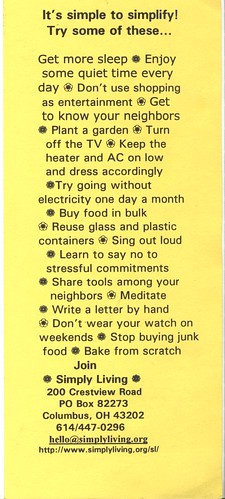
One day I went to a natural foods store in Columbus for some fresh shitake mushrooms (for a fancy recipe, no doubt) and I saw this flyer: a quick guide to living a more simple life. The third suggestion hit me like a ton of bricks: Don’t use shopping as entertainment. Ouch.
***
A few weeks ago, I did go shopping with my mom. After performing a seasonal “purge” of my closet (giving to Goodwill everything I haven’t worn in two years), my wardrobe was in desperate need of some basics. So, I spent a fair amount of money on some new duds—money, I might point out, that I had saved up over the winter for this purpose. After the spree, I felt sick about how much I had purchased (even though, in truth, I needed the stuff). I felt wrong for buying so much and expressed concern that maybe I didn’t need some of it. I said as much later in a conversation with a woman of my acquaintance. She replied, “Oh, I love shopping. I love buying stuff. It makes me happy. It relieves stress for me. And if it feels good, then you should just go ahead and do it without guilt.”
You know when you have a difference of opinion that is so wide there is simply no way to bridge it with a response? Yeah, me too.
***
After my encounter with "the flyer" (which, by the way, lives on my fridge as a daily reminder), I took steps to change my lifestyle. I moved to a smaller, cheaper apartment; I quit buying shit just because I could afford it; I put myself on a "book-buying freeze," denying myself any more books until I had read the ones I owned; I instituted the aforementioned seasonal closet purge; I stopped going out and started reading more; I pretty much quit shopping altogether; I started going to museums instead of movies. I'm still working on saying "no" to stressful commitments, but at least I'm trying.
However, even now when I consider how much of my time I spend engaged in consumption of one form or another, I feel a little sick. As a graduate student/teaching assistant, the vast majority of my job-related tasks demand that I consume something: student papers, e-mails from committees I’m on, class lectures, texts I read for teaching, texts I read for my dissertation, texts I read to “stay current,” e-mails from my students, journal articles, guest lectures by scholars in my field. On the way to and from school, I listen to NPR—I consume my news that way—or I listen to one of six CDs that I have in my car stereo at any one time, CDs which, of course, I buy. I eat (occasionally more than I should). I drink (also occasionally more than I should). I read books for pleasure. I watch Grey’s Anatomy and 24 on a weekly basis. I subscribe to Netflix.
It makes me feel full. I hate feeling full.
I sometimes envy my brother. He’s in construction. He goes out every day and builds houses. He uses his hands and PRODUCES something at work every day. He’s always hungry.
***
I want to read this book on consumerism. But then again, do I? I can't imagine it will ease my mind.
***
For the past year or so, I’ve been on a knitting tear. Last spring I enrolled in a community knitting class through the University of Cincinnati’s Communiversity. Since then I’ve had at least one project on needles at any given time, often more. Right now I have two shawls, two bags, one scarf, one baby hat, one baby sweater, and one knit hat on needles (mind you, few of these items are for me; most notably not for me? the baby stuff.). I get itchy fingers sometimes just thinking about starting a new project.
Knitting has become increasingly popular in the past decade. Some say the trend is celebrity-driven; others believe knitting is part of a larger move toward crafting of all kinds (scrapbooking, sewing, quilting); still others point to the savvy marketing of yarn companies, who have increased production of fun, fast-knitting “novelty yarns” that bring instant satisfaction. I have my own beliefs.
***
Last February, I hosted a “Stitch and Bitch” (some knitting, some wine, some snacks, and lots of talking) at my apartment. We maybe did more drinking and talking than knitting, but it was still a sight to see—young women, knitting needles or crochet hooks in hand, participating in an activity we had been (as products of a feminist era) encouraged to shun as “matronly” and “old-fashioned.” As I looked around the room, I wondered how many of us were, for the first time that day, or even that week, making something, CREATING something, rather than simply consuming. We could have been at a bar or a restaurant, we could have been watching a movie, we could have been reading, or listening to music, or eating. But we weren’t. We were knitting.
***
I’m not saying that knitting is the panacea for all our consumption woes. Obviously, others would argue that we have a lot more to do. But for me, knitting eases stress, it stimulates my brain (patterns are like puzzles—there’s actually a lot of logic and theory involved in knitting), it forces me to sit still and focus on one thing (at least for a while), and, most importantly, it allows me to create something with my hands, to produce something meaningful and beautiful, and to share it with my friends and family.
Saturday, April 29, 2006
catching up
My husband Russell keeps very current when it comes to music. He's always bringing home CDs two months before they're "hits" and his iTunes space is filled with bands I've never heard of, even in passing. Needless to say, he's been enjoying the new Yeah Yeah Yeah's album "Show Your Bones" for some time now.
Me? I'm just now wrapping my ears around the White Stripes, a band whose entrée into the mainstream music scene took place about two years ago. Lately I've been revisiting the bands of Russell's college and post-college days: Kruder and Dorfmeister, Nightmares on Wax, Morcheeba, Portishead--bass beats and electronics--stuff I would have scoffed at in my younger days, but that I now enjoy a great deal. I guess it's easy-listening for a girl who used to blare Led Zeppelin's first album--but I'm getting old.
Anyway, I know critics have panned "Show Your Bones" in the typical "It's their sophomore effort and it's okay that it's not as great as that one song 'Bang,'" but I'll be damned if I wasn't singing "Gold Lion" all day yesterday.
Wednesday, April 26, 2006
and then it all just clicked
Today in class, one of my students said, "I posted late--I didn't get my post done by 10:00 this morning. Is that okay?"
I told her that it was fine, that I was a softie, despite my best efforts to be "tough," and that she'd get full credit.
In my head I was thinking, "Sh*t! I haven't posted to my blog, either!"
As I mentioned in an earlier post, I am blogging with my students during these last weeks of school. Or not blogging, as the case may be.
Anyway, for this particular post, I asked students to write about how they felt about writing--in general or for an online audience. As I walked back to my office after class, thinking about my slacker status and what I might write, I realized that I didn't know how I felt about writing myself. I mean, seriously, I teach writing for a living. How can I not have a ready answer to this question.
I procrastinated for awhile, checked my favorite blog for inspiration, and finally just sat at my computer with feelings of fraud (I can't fulfill an assignment I'm asking of my students) and fear (oh my god, I should just quit school right now!) And then it hit me. Clear as day.
I write to learn, but mostly, I write to teach. I'm a naturally curious person so I ask a lot of questions. Some questions I am willing to let go (Why is female author George Eliot so "mean" to her female characters?) but some I can't (Is Charles Darwin's On the Origin of Species partly responsible for the Eugenics movement?)
And then I research, and I write, write, write. Partly because I want to answer my own question, but also because I think the question is important enough to answer--in writing--so that others can learn as well.
That's probably the most arrogant reason for writing ever. But that's it.
Tuesday, April 18, 2006
can you see the real me? should you?
Last semester I taught English 113, an advanced composition course for first-year students. In order to enroll in English 113, students must place into the course by scoring high on an AP test, or they must submit a successful portfolio to the English Department over the summer. As a result, the vast majority of the students in my class were bright, confident, and savvy about the business of getting where they wanted to go. I mean, these students dedicated a portion of the summer vacation to composing and revising a writing portfolio—they were exceptional students all around.
So, when one of my students visited my office hours to talk with me about a paper, I was a little surprised at this portion of our conversation:
Me: This paper is your second about political issues. Are you thinking about a career in politics?
Student: Um, maybe. I’m not sure yet.
Me: Well, you might consider taking a few courses in political science at any rate—then you can get a taste without having to commit to a lifetime.
Student: Yeah. I want to take some courses. Actually, I wanted to minor in political science. But I’ve heard the professors are extremely *fill-in political leaning* there.
Me: So?
Student: Well, I’m very *fill-in opposite political leaning* and I’m afraid that would affect my grades.
Me (shocked): I mean, I can understand that—but these people are professionals. They will evaluate you on your work, not your beliefs.
Now, I should tell you that the students in my English 113 classes were not shy about making their opinions known. They knew how to present their positions on any given topic. And this student was no exception.
The reason I bring this incident up now is that I’ve been thinking about politics in the classroom. As a teacher, I try to avoid bringing politics into my classroom at all costs. I very consciously “play neutral” in an effort to circumvent any and all political discussions. Granted, this semester I’m teaching an advanced composition course focusing on life narratives, so it’s a little easier to skirt the issues, but even when I teach first-year writing, I try to be as balanced as I can.
Lately, however, this position has me feeling weird and maybe even a little duplicitous. Why should I have to extract a part of myself every time I stand up in front of my students? And conversely, why shouldn't students in my classes have the benefit of seeing that, as a teacher, I can have political beliefs but not allow them to affect my grading policies? I mean, really, it is possible to disagree with someone and still perform your job. And furthermore, wouldn’t it be better for students to know who I am and how I feel just in case I am using my political beliefs as a compass? (I’m not, but what if I was?!?)
I also agree in large part with this blogger; ideas do matter, and if a college writing classroom doesn’t qualify as a safe place to raise issues and ideas and talk about them, to engage in debate and to understand how arguments are constructed, deconstructed, and/or deployed, then I don’t know where else students will learn these things. (Certainly they learn them outside of the academy, but with perhaps more serious consequences for missteps.)
However, there are more reasons to leave my politics out of the classroom. First, sometimes they simply don’t belong. There’s no reason students need to know how I feel on gun control if we’re discussing elements of autobiography. Second, I would hate it if a student didn’t feel comfortable in my class, or avoided taking an English class altogether, because they perceived me to believe one thing or the other.
But sometimes I’m just plain scared.
Recently, the Ohio Legislature floated this bill for an Academic Bill of Rights. This part of it worries me a great deal:
(C) Faculty and instructors shall not infringe the academic freedom and quality of education of their students by persistently introducing controversial matter into the classroom or coursework that has no relation to their subject of study and that serves no legitimate pedagogical purpose.
What, exactly, do they mean by “controversial matter”? And what qualifies as “legitimate pedagogical purpose”? It’s not at all clear to me. And I wouldn’t be surprised if the ruling became more or less rigid with each individual case.
And then there’s this little gem: a new feature at Miami University. Ethics Point. Any student who has a complaint about a teacher can submit an anonymous report to this site. So now I’m under constant threat to avoid “controversial matter,” to make sure every minute of my class serves a “legitimate pedagogical purpose.” Is it any wonder, with such constraints in place, that I chose to keep my politics under wraps?
But I can’t make up my mind...am I failing myself and the students in my classes by not being “real,” by not offering a good example of a teacher with political beliefs, by not opening up my classroom to political discussions so that students can engage with each other in a relatively low stakes environment? I go back and forth all the time.
Friday, April 14, 2006
humility in latin and greek
As friends and family might confirm if asked, I’ve been a bit grumpy for the past few weeks. Spring is quite possibly my least favorite season. I’d take November through February in a minute if I could. Don’t get me wrong, there are some truly wonderful aspects of spring: the hyacinths, tulips, and lilies of the valley are beautiful and fragrant; the fact that I can open up all of the windows in my place makes me happy; baseball season is finally upon us in earnest. These are all good things, I admit.
However, spring also means a TON of work. Student papers pile up, committees trying to wrap up business for the year meet with more frequency (and for seemingly longer lengths of time), the need for letters of recommendation increases. The list goes on and on. However, the real reason I’ve been grumpy lately comes from having to write a STUPID prospectus for my dissertation.
PROSPECTUS: [a. L. pr spectus (- s) a view, PROSPECT n. So F. prospectus (1723 in Hatz.-Darm.).]
1. A description or account of the chief features of a forthcoming work or proposed enterprise, circulated for the purpose of obtaining support or subscriptions. Also, a description or account of the activities of a school or other educational institution.
Now, the bitch of this situation is that I make my students write prospectuses all the time. In fact, as a teacher of writing, I honestly believe writing a prospectus is *the* most useful exercise a writer can do. Even drafting the shortest plan or outline forces the writer to stop for a minute and THINK about what it is she wants to say. I can’t imagine assigning a paper of more than five pages in length without asking for some sort of writing plan or prospectus.
However, when it came time for me to write one for my dissertation (final page count probably in the 175s to 200s) I felt insulted and put upon. Why did I have to take the time to write up this now 30-page document just to explain to my dissertation committee what I was going to write about? Why couldn’t I simply jump into the reading and researching (which is the part I like best anyway)? Obviously my committee is torturing me, I thought.
Mind you, now that I’m almost done with it, I recognize the importance of the exercise. I know I could never write my dissertation without it. But that doesn’t change the fact that I’ve complained about it pretty much non-stop to whomever I can force to listen to me. And that, my friends, makes me a
Hypocrite [a. OF. ypo-, ipocrite (mod.F. hypocrite), ad. eccl. L. hypocrita, ad. Gr. an actor on the stage, pretender, dissembler, f. ]
1. One who falsely professes to be virtuously or religiously inclined; one who pretends to have feelings or beliefs of a higher order than his real ones; hence generally, a dissembler, pretender.
So, there you have it. A nice fat slice of humble pie...
Wednesday, April 12, 2006
the grade vacuum
I do not live in the town where I teach. When I admit (?) to people that I commute from Cincinnati to Oxford in order to study and teach at Miami University, I receive either a.) sympathy (the drive is a little dull), b.) condescension (who would EVER want to live in a city!?!), or c.) censure (you must waste a lot of time and money...).
While response b.) irritates me to no end, it's response c.) that I have the most trouble wrapping my mind around. I mean, sure, gas is expensive. And yeah, I could use the hour and a half it takes me to get there and back three times a week. For a girl who used to run six miles, four or five times a week, yes, the commute can be a real drag. But to me, the time is well-spent thinking. Maybe I'm a little biased, but I sometimes feel that time to ourselves is the first thing that goes when we get busy. Remember when you were a kid and you had hours to imagine? To be curious about the world around you? To wonder how things worked? To contemplate "what's inside that old clock radio" and then take it apart? Gone.
So far this post is taking a rather circuitous route to my main point, which is about grading and response. I spent my drive home today (with my arm out the window--finally, a good driving day!) thinking about the absolutely, completely flawed way students and teachers interact about grades.
Today I returned a long paper to my students. It was a long process on both ends: them writing and me responding. They worked incredibly hard on these papers. They spent weeks germinating their ideas, planning their essays, drafting, getting feedback from peers, trying new styles of writing, etc., etc., etc. We even took time to create a rubric together. They determined what mattered to them in terms of evaluation and we developed a series of criteria for their work. And, without overstating my own contribution to this process, I hope, I spent a good deal of mental energy reading and thinking about their papers. I read them twice, thrice, sometimes even four times in order to make as informed a response as I could.
So, we both go through this process and then BAM. Today I gave them their papers back. And that's the end of the conversation. As students, they get some feedback about their papers. If they want, they can talk to me about my comments and/or revise their work. But for the teacher, that's it. We never know how our comments "went down."
Grading is such a sticky business in the first place. It's absolutely subjective (and anyone who tells you otherwise is a bald-face liar) and it's painful and it's awkward and it's stressful (not the reading, mind you, the responding--you want to say it just right) and then it's over and you never really know if it was any use at all. I hate that. In my opinion, the vacuum that's created when the papers leave the teacher's hands and go to the student's is the source of a lot of teacher burnout and frustration. It's like a boomerang that never returns. You just wonder where it went.
The class I'm teaching now (English 225) is one of two courses required by future English teachers. I sometimes feel that I should raise these issues in class, that we should all talk about grading as a process. They're going to have to do it, too, and they're going to feel just as conflicted as I do. As all teachers do, I think. Why don't teachers ever talk about this issue? Even typing it out right now seems weird, as if I'm supposed to "know" that my comments are helpful. Teacher as authority--what a farce!
Friday, April 07, 2006
welcome
to my blog. My name is Jen.
In the coming weeks, my students will be learning how to create and post to their own blogs. Rather than be the teacher who creates assignments for her students but won't try them herself, I'm going to take part in this exercise. After reading Jim Corder's 1979 essay "What I Learned in School," I think twice about asking my students to write or produce something that I wouldn't. So here it is: a blog for class.
(By the way, if you teach writing, or you plan on teaching writing, I highly recommend Corder's work.)
I have some serious reservations about participating in this assignment, though. I worry that I'll somehow stifle my students' creativity, purposes, or voices by entering what they might wish to be their own space (even as I acknowledge that my students have agency and can do whatever they please). I worry that I'll smudge the lines between teacher and student in such a way that we'll all feel awkward or uncomfortable.
I also worry a little that my nerdiness will horrify them, but not too much: after a semester I guess they've made up their minds on that score already.
And so it begins...
The title refers to two hobbies of mine: one lifelong (writing) and one current (knitting).
Subscribe to:
Posts (Atom)